How to Convert TRCN to QTS and Teach in UK (earn £52,834 / year)

Last updated on August 6th, 2026
Steps to convert TRCN to QTS is to first confirm your eligibility, then submit QTS application with required documents to UK DfE, before requesting Letter of Professional Standing and getting approved.

Knowing the exact documents DfE requires and how to apply for this TRCN to QTS conversion yourself will save you from delays and scammers promising shortcut.
This guide shows step by step how to convert TRCN to QTS from Nigeria and your UK Salary Scale once you get QTS.
Quick highlights
- Nigeria has been eligible for the UK free and direct QTS conversion route since February 2023.
- Newly qualified teachers start at £34,069 outside London to £45,000 for an experienced main scale teacher, £52,834 on Upper Pay Range and £148,829 for leadership roles.
- Your Letter of Professional Standing is requested only after DfE asks for it, and sent directly to TRA by TRCN.
- QTS is just a professional licence, not a visa or job offer.
- Teachers outside the eligible subjects can still relocate via iQTS and the Assessment-Only routes.
In this post
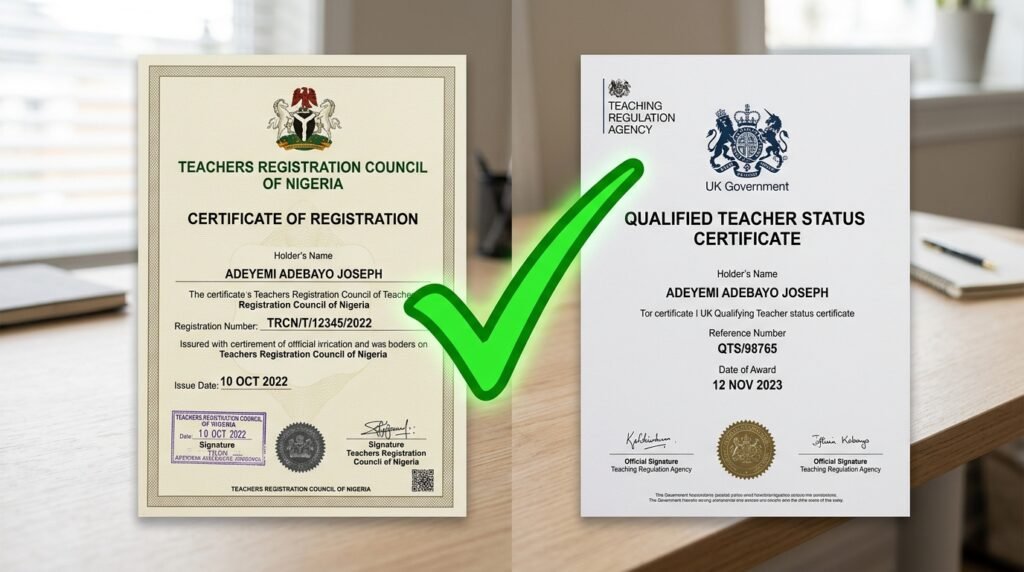
Direct conversion of TRCN to UK QTS
Yes. It is possible as Nigeria has been eligible since February 2023.
This is the cheapest UK relocation path for Nigerian teachers, provided you meet the criteria as follows.
- A Bachelor’s degree, not NCE or TC II.
- And the degree must be in an eligible subject.
These confirm your eligibility to convert TRCN to QTS.
And the whole process to get QTS with TRCN starts with the breakdown of these eligibility criteria in applicable steps.
Step 1: Confirm you meet the eligibility criteria
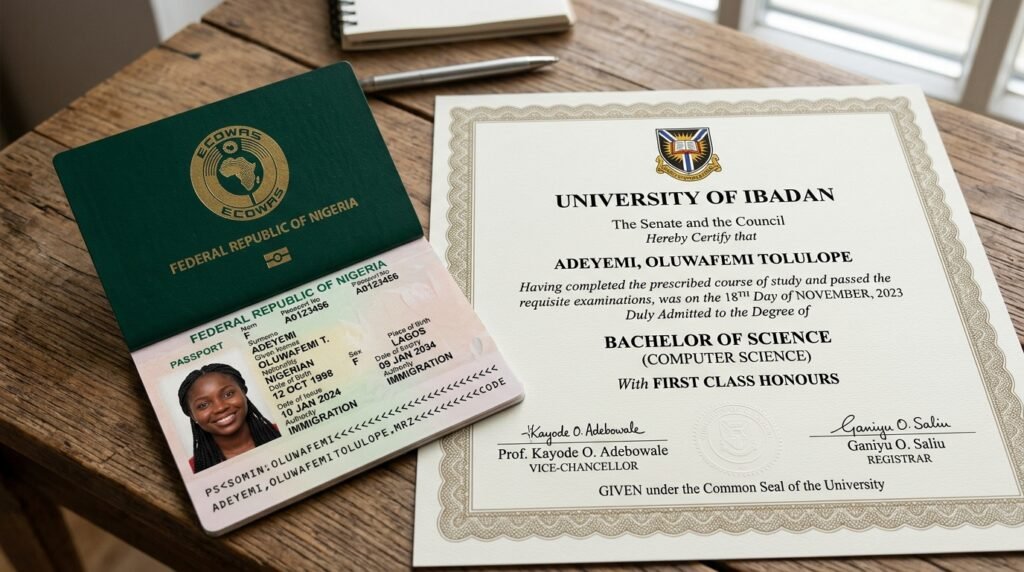
You need a valid international passport and a bachelor’s degree or higher with academic transcript.
Your qualification must be in one of the eligible subjects for teaching pupils aged 11 to 16:
- Mathematics
- Science
- Biology
- Chemistry
- Physics
- French
- German
- Italian
- Japanese
- Latin
- Mandarin
- Russian
- Spanish
And at least one full school year (9 months) of teaching experience counted from after getting your TRCN license, not before.
Confirm you meet each of these criteria before applying to convert TRCN to QTS because skipping any of them is immediate rejection.
Step 2: Submit your QTS application to UK DfE

Gather your documents to submit on the UK Department of Education (DfE) portal once your eligibility is confirmed.
The portal will request these extra documents
- A Statement of Comparability from UK ENIC confirming your Nigerian degree is equivalent to UK standard.
- Proof of English proficiency, either with IELTS for UKVI at CEFR level B2 or a Medium of Instruction (MOI) letter from your university.
- Reference letters from the school admin email addresses where you teach (or have taught) to verify your experience. Letters from personal email addresses are not accepted.
Submitting complete transcripts also determines how fast the Teaching Regulation Agency (TRA) will process your Qualified Teacher Status certificate.
Any error or missing document here will delay your application, so check everything before you submit.
Step 3: Request TRCN Letter of Professional Standing

This is step three because you shouldn’t request your Letter of Professional Standing before applying to the DfE.
Wait until the DfE has assessed your application and directs you to contact TRCN for it.
And TRCN sends your Letter of Professional Standing directly to the Teaching Regulation Agency via the designated verification channel.
Never will they send you the letter to forward it yourself.
Pay the ₦250,000 fee to TRCN via Remita and never to third party agents advertising “fast track” service on Telegram or Facebook.
Third parties will submit a forged or manipulated letter which can get you banned from all UK immigration process for life.
Once your Letter of Professional Standing is sent by TRCN, track its delivery to the TRA rather than assuming it has arrived because you’ve paid.
Step 4: Receive QTS and start UK job search

The Qualified Teacher Status is a professional licence, not a visa, job offer or the right to live in the UK.
Once you convert TRCN to QTS, register on the official DfE Teaching Vacancies portal and filter for roles with visa sponsorship.
Having the Qualified Teacher Status makes you more attractive to most schools who prioritise candidates with QTS.
So, get QTS with TRCN and up goes your chances of getting a UK Teaching Job with Visa Sponsorship.
Step 5: Get Certificate of Sponsorship and apply for visa
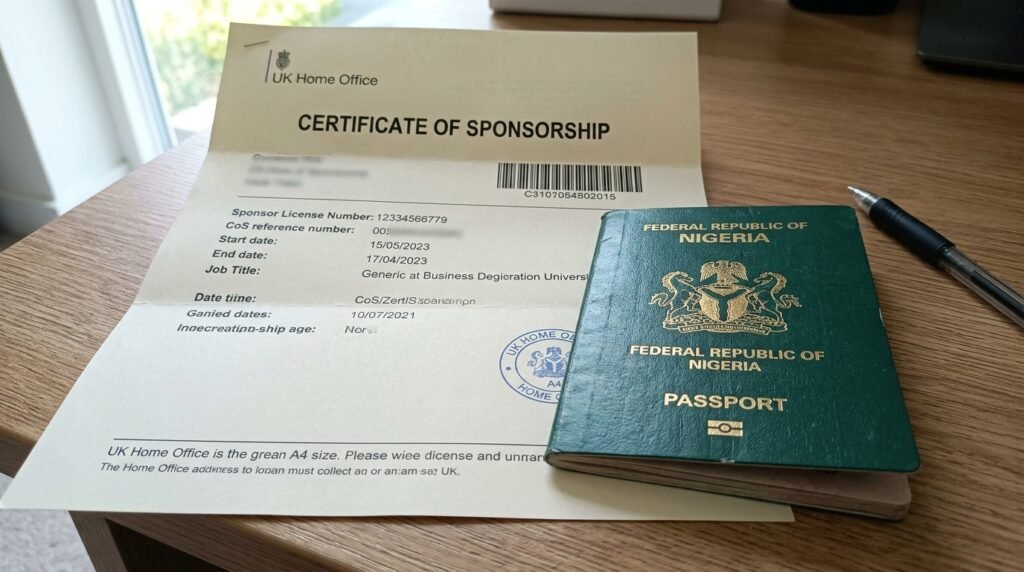
Once a school decides to hire you, its HR or admin issues a Certificate of Sponsorship (CoS).
Use the CoS to apply for your UK Skilled Worker Visa online.
Since teaching in UK is under the national pay scale exemption, Certificate of Sponsorship guarantees your visa approval
But budget for all the expenses associated with your visa and relocation. CoS doesn’t pay them.
- Application fee.
- Immigration Health Surcharge.
- Flight ticket.
- Accommodation.
- Feeding.
- Miscellaneous.
How much will you earn after converting TRCN to QTS?

Effective from September 2026, a newly qualified teacher starts at about £34,069 outside London.
Teachers with more experience and at the top of the main pay scale earn around £45,000.
The Upper Pay Range reaches £52,834 outside London.
Leadership roles, like Deputy and Head teacher positions, are around £53,586 to £148,829 at the very top of the range.
Each of these figures rises further inside London.
Hope this potential earnings encourages you to start or complete your TRCN to QTS conversion and relocation, no matter the challenge.
Challenges when converting TRCN to QTS

Agents overcharging for Letter of Professional Standing processing is the first problem.
Avoid them.
Another is the risk of delay by TRCN registry which can push your letter too close to or even beyond the DfE’s 90-day expiration window.
So, stay in regular contact with TRCN throughout.
Finally, getting QTS doesn’t guarantee a UK teaching job.
Don’t underestimate the mental and financial strain of the job hunt that follows QTS approval.
Alternatives if unqualified for TRCN to QTS conversion

If you teach a subject outside the 13 eligible Shortage Subjects, consider alternatives beyond TRCN to QTS.
The International Qualified Teacher Status (iQTS) route is an online training program done in Nigeria through an approved UK provider and open to all subjects.
The Assessment-Only route also exists for those with 2+ years of experience who do not teach the shortage subjects. Though, it requires you to already be working in a school inside England.
A standard PGCE remains a solid alternative if neither of the routes above fits your circumstances. It requires relocating to the UK on a student visa, except the iPGCE (often without automatic QTS).
For a full breakdown of these alternatives, see other QTS Pathways available to Nigerian Teachers.
FAQs on converting TRCN to QTS

1. How long does TRCN to QTS conversion take?
About 12 months from initial application to final Qualified Teacher Status decision.
Though a large majority of applications process sooner once the Teaching Regulation Agency has received all your verified paperwork without delays.
2. Does TRCN send the Letter of Professional Standing automatically?
No. You must initiate both the request yourself, but only after the DfE has directed you to do so following its initial assessment of your file.
3. Can non-STEM or non-language TRCN teachers still convert?
Not through the direct free route as it’s restricted to just the 13 eligible shortage subjects.
But iQTS and the Assessment-Only routes remain available to teachers outside this subject list.

Conclusion
Use the GOV.UK “Apply for QTS in England” service to check your eligibility and submit your documents.
Use TRCN portal to request and track your Letter of Professional Standing once the DfE directs you to.
Beware of unofficial websites promising fast tracked visas or guaranteed jobs in exchange for a fee.
Verify every guideline on converting TRCN to QTS via official sites, then start your first real step towards your relocation to teach in the UK.
Can this help others? Share it. Got a question? Comment below.